
All instruments
Practice
iterative phases | details | extensions
Perceive

Diagnose

Analyse

TOOLBOX

Decide

Apply
Becoming their own teacher
The Phases of Practice
Ideally, practising involves moving through a series of iterative phases. There are various ways of dividing up and naming these phases. A very concise, yet practical, sequence is: Find the problem – Isolate it – Understand it – Fix it, whereas "fixing" in the narrower sense, means "practice". For our purposes, we have chosen a sequence that takes into account both those who practise and those who teach. We have expanded the classical phases, among other things, to include a specific perspective on the Toolbox, as it holds untapped potential for greater variety and ease.
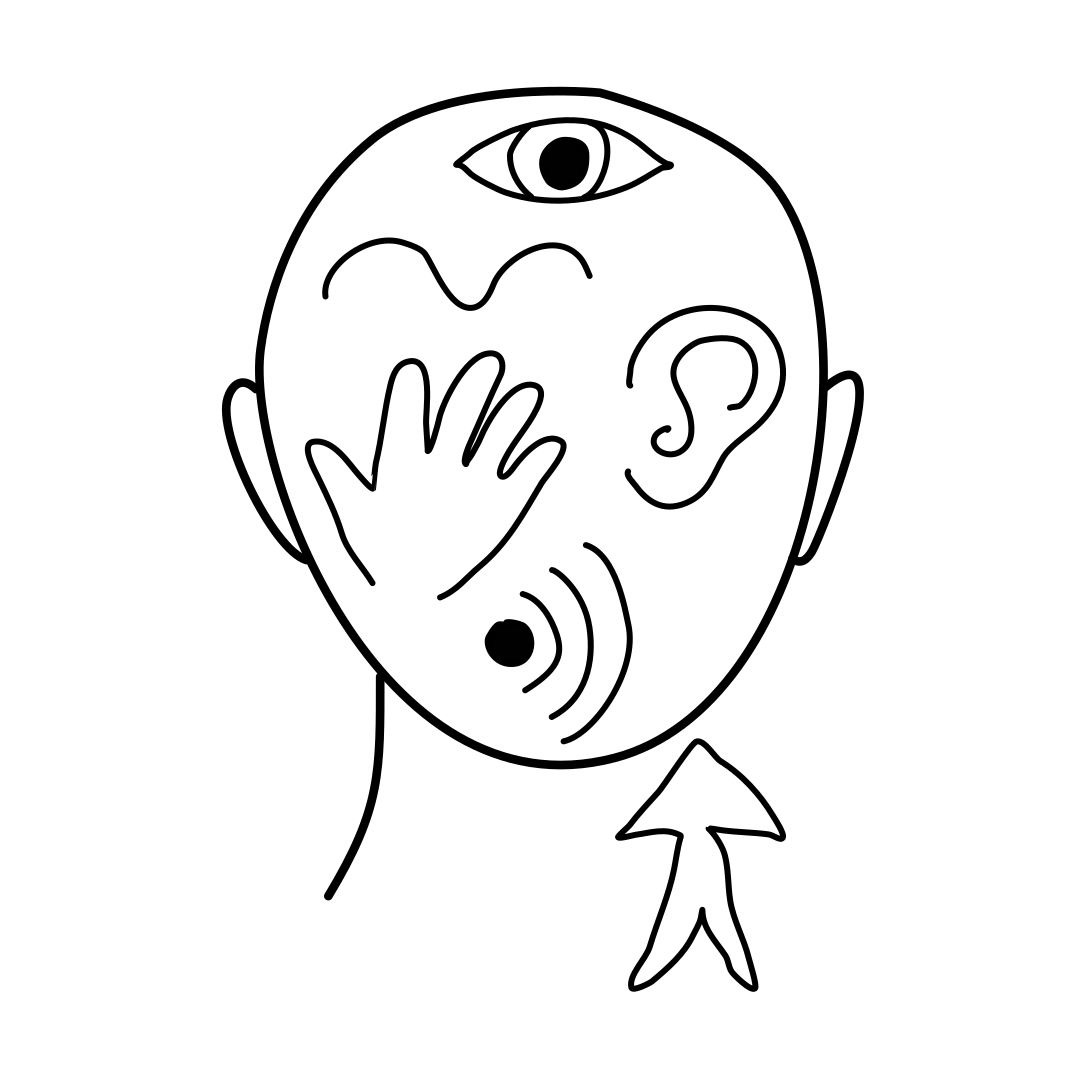
The willingness to perceive consciously is an essential prerequisite for effective and purposeful practice.
The focus is on the ‘how’. Developing perceptual awareness is an integral part of teaching. Through reflection, targeted questions and other approaches, learners gradually develop a more differentiated awareness of what they are playing and learn to put their perceptions into words.
The following perceptual channels are generally available to us when practising:
- Auditory (hearing) - listening to one’s own playing; perceiving intonation, tone quality and ensemble playing
- Visual (seeing) - reading the music; looking at fellow performers; observing movements
- Kinaesthetic (movement) - perceiving one’s own movements and their sequence
- Tactile (touch) - perceiving contact, pressure and touch
- Proprioceptive (body awareness) - perceiving posture and tension
Depending on the learner’s age and stage of development, the teacher may take on the role of perceiving and identifying these aspects..

The better we perceive, the more accurately we can diagnose the areas that require attention at a given point in time.
The focus is on the ‘what’. We typically consider the following parameters:
- Instrumental technique - finger technique, bowing, articulation
- Rhythm - pulse, timing, precision
- Tone - tone quality, timbre, resonance
- Intonation - pitch, intervals, tuning
- Expression - dynamics, phrasing, articulation
- Interpretation - style, tempo, musical shaping
Depending on the learner’s age and stage of development, the teacher may take on the role of diagnosing these aspects.
With increasing experience, we become better and better at identifying the underlying cause of a problem.
The focus is on the ‘why’. It is not uncommon for there to be several causes, or even chains of cause and effect. Compared with diagnosis, analysis is considerably more demanding, as it may be necessary to experiment in order to find out what is actually causing the problem. It is advisable to break the problem down into its smallest components and set off on an exploratory journey.
We generally consider the following possible causes:
- Instrumental causes
- Rhythmic causes
- Tone-related causes
- Intonation-related causes
- Musical causes
- Physical causes
- Mental causes
Within the relationship between learner and teacher, the teacher’s role is particularly important here – especially when working with very young learners.

We rarely start with a ‘blank sheet of paper’ – or an empty toolbox.
The toolbox can also be thought of as a treasure trove or as the heart of the practice process. Ideally, it grows over the years and contains a wide range of solutions. A learner’s toolbox will look different from a teacher’s: as learners, we need the solutions that work best for us, whereas teachers need the best solutions for a wide range of different learners. Here is a selection of popular practice approaches:
Accentuate | Gradually increase the tempo | Play through | Practise backwards | Practise in loops | Practise in sections | Practise mentally | Practise parts separately | Practise slowly | Practise with a metronome | Practise with altered articulation | Practise with stops | Practise without a metronome | Repeat | Simulate a performance | Sing and play | Vary the dynamics | Vary the rhythms
There are also aspects to consider when building a systematic and diverse toolbox. They include the following approaches:
- Exercises that specifically address the different perceptual possibilities introduced in Phase 1, with a minimum focus on auditory, visual and kinaesthetic perception.
- Expanding the portfolio with exercises and approaches that additionally incorporate the element of simultaneity. Watch the explanatory video here
We are continually developing these approaches and ideas. We make the results available to interested learners and teachers in the form of tips, online courses, booklets and workshops.
At a glance, what has been done so far:
- for all instruments:
activate balance while practicing | do your body some good | food roller method | integrating the body - conscious activities | musical phrasing | sense of rhythmic stability for playing technique and musicality
- additionally for string players:
bow attachment | fingerboard attachment | beginners´lessons
- additionally for high string players:
left-hand pizzicato as a practicing technique (LHP) | fine motor skills | vibrato - all types

Which tool from my toolbox should I choose? Is there a solution in my toolbox at all?
The more diverse the approaches in our toolbox, the more difficult it can become to find our way around it. If we become overwhelmed by the choices, this is often a sign that the analysis phase has not yet been completed satisfactorily.
Of the estimated 20,000 to 30,000 decisions we make every day, around 95 per cent are thought to be guided by our autopilot – that is, made unconsciously. Alongside these, there are countless everyday decisions: What should we wear? Tea or coffee? Truly major and complex decisions, by contrast, are relatively rare. It is therefore worth treating the choice of a particular exercise as a significant and conscious decision, so that we can address the underlying cause of the problem as effectively as possible.
One aspect of decision-making is easily overlooked: we can also decide that there is no suitable solution in our toolbox.
Decision-making is an area in which both learners and teachers continue to develop, as the outcomes of our choices generate experience, which in turn informs our future decisions. The more a teacher experiments with different approaches, the more the learner also develops an understanding of how to make such decisions.

Applying the chosen solution usually takes up the most time.
To keep this phase effective, it repeatedly cycles through phases 1–5 described above: every, however brief, attempt to apply or execute the chosen approach must be perceived – and so, inevitably, the process begins again from the start.
The teacher supports the learner until they understand how to do it and what to pay attention to. Once they practise the diagnosed passages at home as discussed in the lesson, they begin to build up their own experience. This provides a valuable basis for the next lesson.
 Take part in our international study on practice
Every opinion is valuable and helps us to better understand practising as an important aspect of musical life! Click on the image to take part and find out more!