
ALL VARIATIONS AT A GLANCE
Differentiated Rolling with the Foot Rollers
There are different ways to roll the foot rollers. Each has its own benefits.
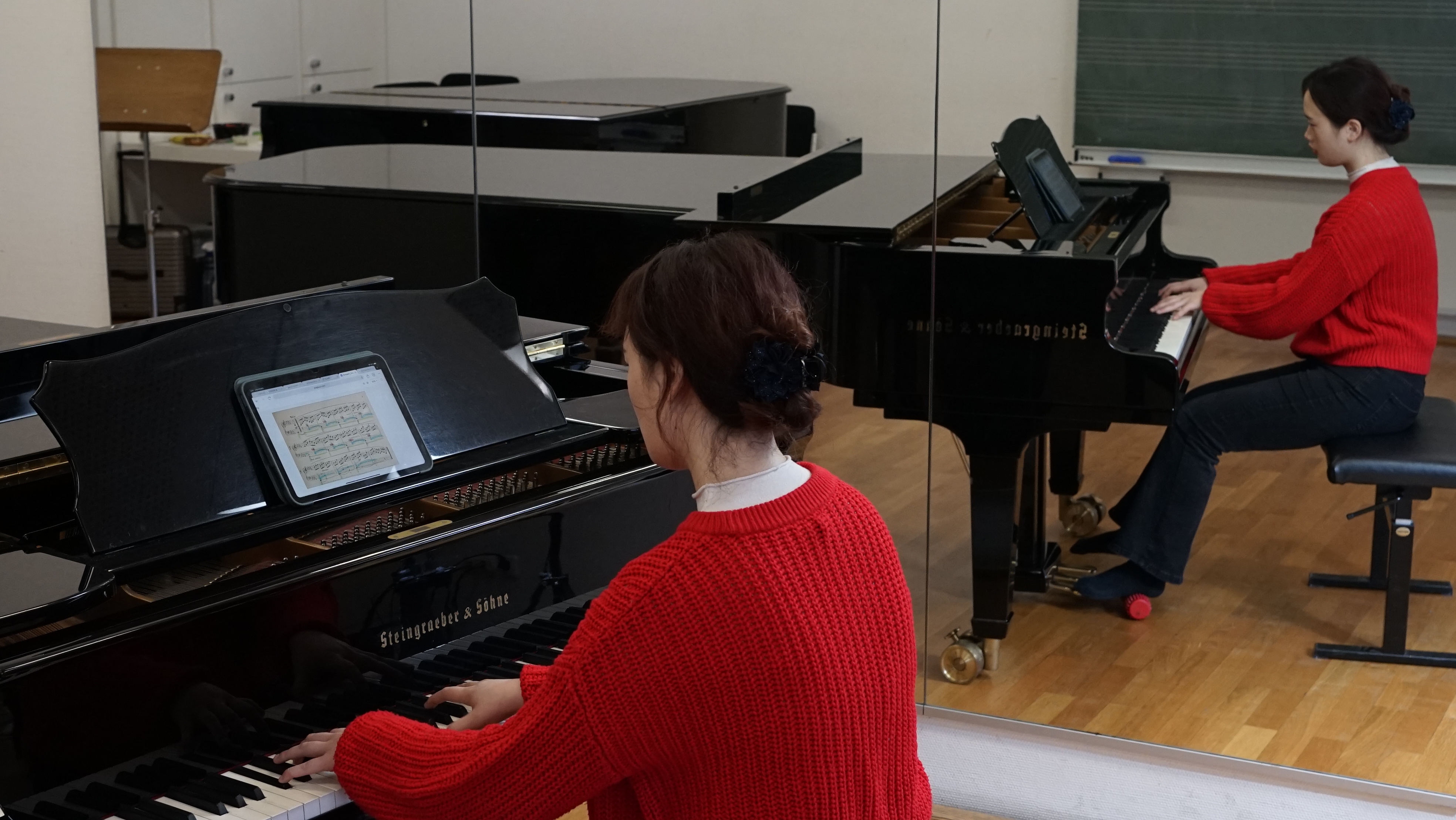
Whether standing or sitting, the foot rollers can be used in a variety of ways. The video alongside first demonstrates the basic techniques:
- Sitting: parallel (pink) and in opposite directions (green)
- Standing: with one foot
These are just the basic techniques. The key lies in how they are used.
Moving the Rollers
We distinguish between two types: “impulse-driven” and “guided”.
- Impulse-driven: The rollers are moved with a large, sweeping motion. There is a clear beginning and a clear end — the latter occurring when the momentum runs out. Most people start with this approach. It shows very clearly whether you are truly in sync when playing both feet simultaneously. One of its advantages is that you can simply let your feet go. Impulse-driven rolling is useful for training vertical rhythmic stability.
- Guided: Here, the aim is to perform the rolling motion slowly and with control. There is also a clear beginning and end to the movement. It is somewhat more challenging to execute precisely. Guided rolling supports horizontal rhythmic stability and musical phrasing.
We recommend starting with the impulse-driven approach and then practising both variations. And we recommend being a little more patient with the guided approach. It requires a different kind of concentration.
Just to avoid any misunderstanding: the aim is not to roll for the sake of rolling. The focus is on synchronisation — playing and rolling at the same time and connecting the two in a meaningful way, regardless of how well you can play or roll. As you practise the rolling consciously and deliberately, your playing will also change. We recommend the introductory course “Phrasing”.
You really need to experience this for yourself - writing about it doesn’t convey very much.
Further information
-
 Foot roller method
-
 Phrasing