
The Foot Roller Method for musicians
 Foot roller method
The so-called Foot Roller Method (FRM) has a long and traceable development history. Its origins reach back to the late 1990s, when I began exploring ways to make musical phrasing arcs physically tangible for students and entrance exam candidates particularly through targeted walking movements. The goal was to bring the movement of the legs and feet into a continuous, uninterrupted flow, thereby fostering an inner sense of stability in musical expression. The transition from one step to the next proved to be both a major challenge and a valuable indicator: the smoother and more connected the movement, the more coherent the musical performance tended to be. Players received direct, bodily feedback about the alignment between their inner conception and its tuneful realization.
- A review by Erdmute Hohage, the inventor of this method
A second, decisive stage of development began around 2010 - initially as an experiment. Together with Angelika, I started placing objects under the soles of the feet to anchor rhythmic precision in a tangible way. While rehearsing a rhythmically complex duo, we used simple tools such as balls under our feet, moving them in time with the meter. This playful approach turned out to be not only effective but also unexpectedly insightful.
About four years later, we began using massage rollers for the first time - and with them came a new level of differentiation: between vertical rhythmic stability and horizontal stability in the sense of musical phrasing. Thus, the topic of physically supported phrasing reentered my teaching, though I was not initially aware of how directly it continued my earlier experiments.
Although formalizing a “method” had never been my goal, the deliberate use of the feet gradually became an integral part of my teaching over the following years - across a range of subjects, from questions of vibrato to issues of sound shaping. Even my youngest students have long been encouraged to use their feet consciously. More advanced students and professionals now develop their own applications and variations based on this basic, which I find especially rewarding, as I have always viewed my teaching as a source of inspiration rather than a mere transfer of methods.
In the most recent phase of development, the question arose whether the technique could be made systematically applicable to all instrumentalists and singers. Together with Angelika, we revisited all previous approaches, conducted new experiments with various instrument groups, chamber ensembles, and orchestras, and eventually arrived at a structured process. Angelika’s key contribution was to condense the complex relationships into just four clearly defined steps. The result is a practical guide that offers musicians of all levels an accessible introduction to working with the FRM:
- Internalization of vertical rhythmic stability
- Refinement of vertical foot movement within the meter
- Transfer to horizontal stability (direction of phrasing)
- Musical phrasing based on physically grounded movement
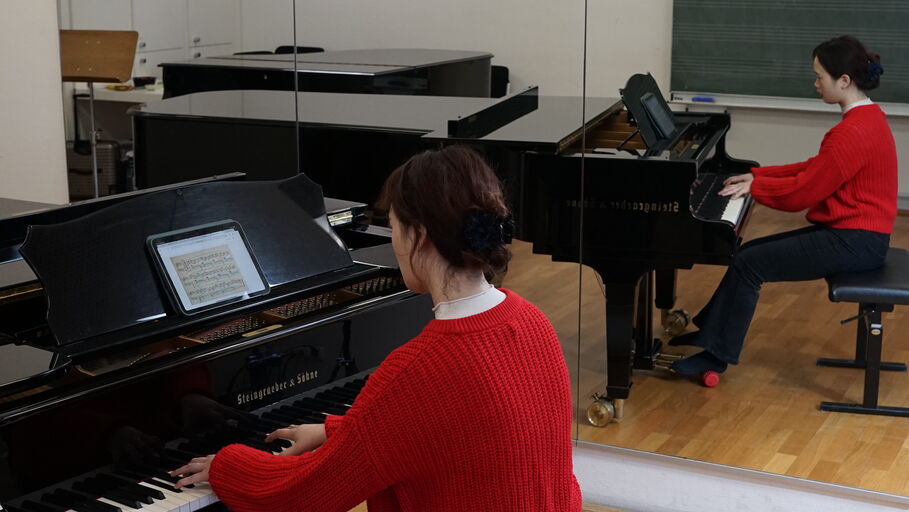
Ideally, these steps build upon one another, yet they can also be applied flexibly or modularly depending on musical context and individual goals. We chose the piano as our example instrument, since - similar to the higher string instruments - it requires a particularly high degree of coordination between sound, rhythm, and movement, and its technical fundamentals are widely familiar.
While working on the recordings for the guide, I experienced one final, formative insight: the fourth step - the conscious shaping of a musical phrase - works reliably only when the passage being practiced does not yet have an established inner image, or when the existing conception has not yet been convincingly realized. This realization deepened my understanding of the technique’s potential even further.
I wish all musicians who embark on this exploration much curiosity, joy, and success. The Foot Roller Method does not only open new pathways toward rhythmic stability and phrasing but also strengthens the connection between body, sound, and musical intention.