
Tuneful and Colourstrings
 Tuneful and Colourstrings: Similarities, differences - and a closer look
If you briefly flip through the Tuneful books and the Colourstrings ABC books – and often that is all the time we have – many similarities become apparent at first glance. But it is the closer look that reveals what the two have in common and where they differ. This article offers that closer look.
We take a closer look at our Tuneful Approach and the Colourstrings Method developed, among others, by Géza Szilvay, exploring what the two approaches have in common and what distinguishes them.
We are the authors of the Tuneful series. We are very familiar with Colourstrings, having attended courses with Géza Szilvay over an extended period and subsequently taught students using the approach. This article was prompted by questions we have been asked that relate directly to Colourstrings (CS). Broadly speaking, these fall into two categories:
- Is Tuneful (TF) a “light” version of CS?
- How does TF differ from CS?
We do not claim that the following discussion is exhaustive. Nor is a direct one-to-one comparison possible because – as we will discuss later – CS is more a method than a repertoire, while TF is more a repertoire than a method. In what follows, we outline some of the similarities and differences, focusing on the violin editions.
A short contribution by Angelika S. Schepke and Erdmute Maria Hohage
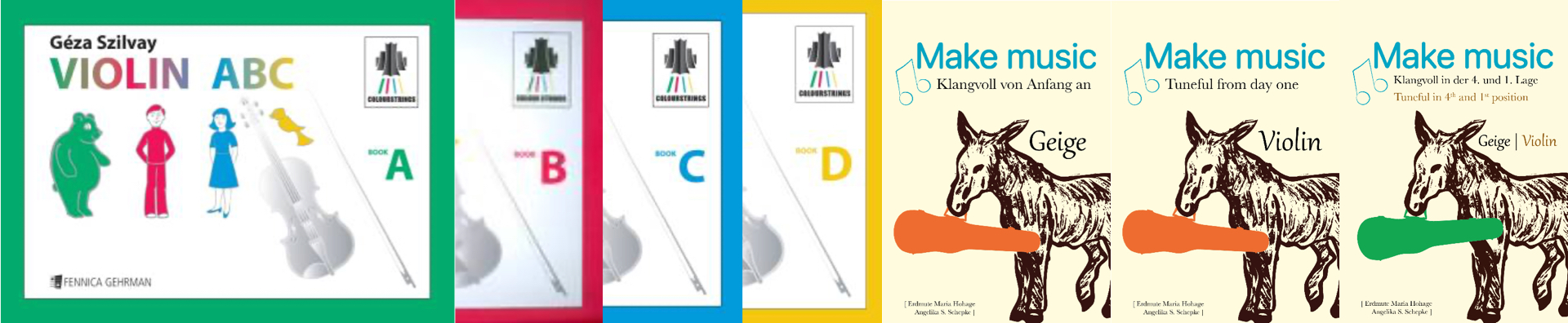 Colourstrings ABC and Tuneful series from Make music
Colour-coded notes:
Both use colour-coded notes at the beginning.
Some similarities become differences when viewed more closely and analysed in greater detail:
Symbols and drawings
Both use a range of symbols, but they are used differently. In CS, symbols are primarily used for explanations and introductions, as well as age-appropriate prompts relating to notes, musical concepts, and so on. In TF, by contrast, they mainly indicate different ways of practising or performing something.
Exploring the entire fingerboard
Both approaches aim to explore the fingerboard as early as possible, but they do so in distinctly different ways. In CS, the fingerboard is divided into two or three areas: the Sun and Bird areas, as well as first position. These are explored primarily through the use of harmonics. TF divides the fingerboard into four colour-coded areas: yellow, pink, green and brown. Starting from the green area, these are explored primarily through left-hand pizzicato as a practicing technique (LHP).
Use of harmonics
Both approaches make extensive use of the advantages of harmonics, but in distinctly different ways. CS uses them in the Bird and Sun positions and uses harmonics to introduce the placement of the second, third and fourth fingers in first position. Overall, CS introduces harmonics somewhat later than TF. In TF, the harmonic is present from the very beginning and serves as an “anchor” for the centre of the instrument. Regardless of which position is played later on, it is repeatedly brought back into the learning process.
Left-hand pizzicato
Both approaches make extensive use of left-hand pizzicato, but with different applications and intentions. In CS, it is only marked as such later on, using the characteristic “+”, and is used in the narrower sense as a variation of playing technique (without the strong finger pressure normally required for left-hand pizzicato). It forms part of the songs and can serve as an option for how they are performed.
In TF, left-hand pizzicato also appears in the songs, again as a variation of playing technique (without the strong finger pressure), but it is systematically developed as a practicing technique (LHP). From Unit 15 onwards, it is also notated in two parts in order to specifically develop rhythmic stability, coordination and release. In addition, TF recommends using different ways of plucking.
The kinaesthetic channel of perception
Among the distinctive characteristics of the CS violin books, the preface to the accompanying booklet describes CS under the heading “The functional connection of the senses” as a visual-auditory experience (translated from the German edition into English by the authors):
The COLOURSTRINGS ABC uses the principle of enhancing perception through the functional connection of the senses: each new element is introduced in such a way that it is experienced and understood simultaneously through two senses – visual and auditory. In this way, new material is internalised particularly deeply and durably.
We would like to attribute also a kinaesthetic component to CS, even though it is considerably less pronounced than its visual-auditory approach. We use the term kinaesthetic when there are specific practice approaches for something that focus on movement. To avoid any misunderstanding: this is not about playing or making music itself, which is, of course, movement in its purest form. Rather, it refers to specific ways of practising that can typically be found in a toolbox and used as needed – in other words, ways in which information is processed. We will return to this topic in greater detail elsewhere.
In CS, the use of the feet is encouraged. It is very rarely “notated” (e.g. at the end of Book A and in the middle of Book B), but it has been passed on orally that using the feet is beneficial. There is no systematic use of the feet, nor do they have a particularly prominent role. Nevertheless, we feel that this aspect deserves to be mentioned because it touches on an important dimension of learning that is generally underrepresented in education.
TF integrates the feet much more intensively and systematically. A distinction is made between synchronised use with the rhythm, for example of a song, and a different kind of metrical subdivision. The feet are integrated from the very beginning and increasingly developed as an independent layer. TF also recommends using foot rollers as an early introduction to the possibilities offered by the Foot Roller Method. In TF, they are an important and extensively developed practice tool.
Some differences remain differences, even when viewed more closely:
Songs and Lyrics
One aspect to consider is the number and “visibility” of songs in the books. CS includes comparatively few songs in its ABC books. Moreover, they are not always readily identifiable as songs in the narrower sense, since, from the children’s perspective, there is no visible text or similar indication. The lyrics have to be added by the teacher. As a kind of “substitute” for the lyrics, the singing of the songs with the use of solmisation can be understood as fulfilling a similar function; solmisation is an integral part of the method. The songs in the ABC books are also closely linked to supplementary material. According to information provided orally, the songs are also always intended to be played in different registers and keys.
TF, by contrast, introduces two new songs or short pieces in each unit of Book 1. Book 2 is a collection of more than 100 songs from 26 countries. This distinction is not intended as a value judgement. There is simply a significant difference from the perspective of the children, who often look for songs specifically and directly. In Book 1, the lyrics are immediately visible to the children and can therefore also be incorporated visually into their practice. In Book 2, the lyrics in the original language appear directly beneath the notation, while a translation or summary of the content is provided in the accompanying teacher’s book.
There are also differences from the teachers’ perspective. In CS, teachers are explicitly encouraged to add further songs on the blank teacher pages provided for this purpose, for example melodies from the relevant cultural context.
“Practice” and “Technique”
In CS, “practice” and “technique” are closely interwoven with songs and short pieces in the ABC books – so closely that a child is unlikely to perceive any distinction between them. TF, by contrast, places greater emphasis on the areas of “practice” and “technique” through its structure and layout.
In Volume 1, each teaching unit is divided into three areas for the development of: a) the left hand, b) the right hand, and c) music-making. In Volume 2, each chapter contains three areas: a) a technique page for developing the left hand and basic coordination, b) songs, and c) technique pages focusing on bowing technique, finger technique and, where appropriate, scales.
Exercises for developing playing technique and coordination, as well as different ways of practising something communicated through icons, are given much greater prominence in TF.
Systematic finger placement / playing position
One area in which the two approaches differ in emphasis concerns early orientation on the fingerboard. CS gives children early access to the instrument as a whole in a broad musical context, developing orientation through sound, patterns and relationships across the entire fingerboard. The first playing position in which the fingers are learnt systematically is first position.
TF also considers which playing positions may support certain principles of physical organisation in the long term. The approach initially focuses on the centre of the fingerboard and introduces fourth position as the first playing position. The aim is not to introduce technical difficulties prematurely, but rather to make certain movement relationships tangible at an early stage. Fourth position is therefore not regarded as a specialised technique to be introduced later, but as a possible learning environment in which certain physical foundations can be developed early on, bringing a range of benefits and facilitating later learning.
While CS therefore introduces systematic finger placement in first position, with other positions being added considerably later (in the narrower sense of shifting between positions – the intention is that songs in CS should also be played in other positions and keys, even though this is not explicitly notated), TF focuses on the centre of the instrument and prepares for finger placement in fourth position. Volume 1 of TF can also be used if systematic finger placement is ultimately to be introduced in first or any other position.
This is probably the most significant difference: CS takes first position as its point of reference, while TF takes the centre of the instrument as its point of reference.
Division of the fingerboard
As mentioned above, CS divides the fingerboard according to harmonic criteria: the Sun area, the Bird area and first position. TF, by contrast, divides it into four areas distinguished by colour.
This results in an emphasis on the auditory exploration of the fingerboard in CS, whereas in TF, kinaesthetic-auditory exploration is more prominent. Through the spacing of the harmonics, the division used in CS tends to encourage larger movements. In TF, by contrast, finer movements can also be supported as required.
As mentioned above, CS can be understood as a fully developed method, whereas TF is not intended as such. We do not know whether Géza Szilvay would agree that CS was developed from a philosophy, or that there is at least a philosophy underlying CS, but this is how it feels to us. In our experience, this philosophy is an integral part of CS, particularly in ensuring that it does not become a “light” version by picking out individual aspects. This is not something that needs to be reinvented.
TF, by contrast, is more of a repertoire that can work very well with all kinds of teaching approaches. There is also plenty to discover here, for example the wide range of recommended ways of practising, with new areas of focus, practice techniques and, of course, direct finger placement in fourth position. TF essentially came about because we wanted to adapt the approaches to practice that had already been developed more generally and make them directly accessible to beginners.
And now for the similarity: the same applies to both CS and TF. What ultimately emerges from either of them, and what each person takes away from them, depends crucially on the teacher. As teachers, we are at our best when we use something that we can genuinely embody and communicate with conviction. Ultimately, any method or repertoire is only as good as the people who use it.
And what, then, remains to be said about the first question?
We have outlined some of the similarities and differences above. There are many other aspects that could be considered, for example the ways in which the approaches can be used or how children can play together, as well as how teachers learn the method or use the repertoire.
Whether one can “do a bit of Colourstrings” is something each person must decide for themselves. One thing should be clear, however: if you use TF and think you are doing a bit of CS, then in our view, that misses the point. The same would be true the other way round.
With this in mind, we wish everyone every success – with or without Tuneful or Colourstings.